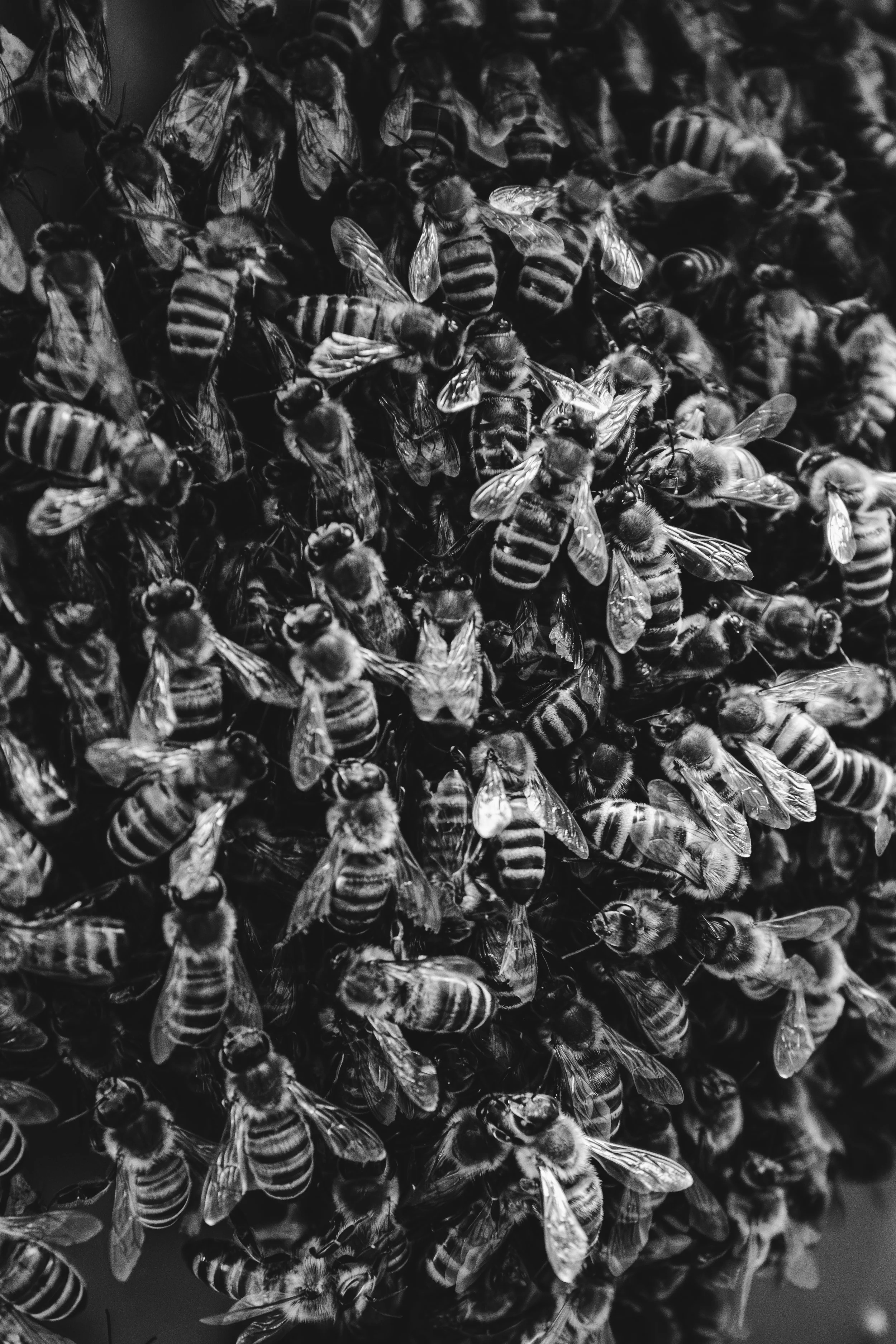
I keep trying to pick out one bee in the second photograph. I find a head, follow the body, then discover I’ve moved onto its neighbour. There are quite a few wings to account for.
It’s a little like looking for someone outside a busy station. You know roughly where to look, but everyone else is there too.
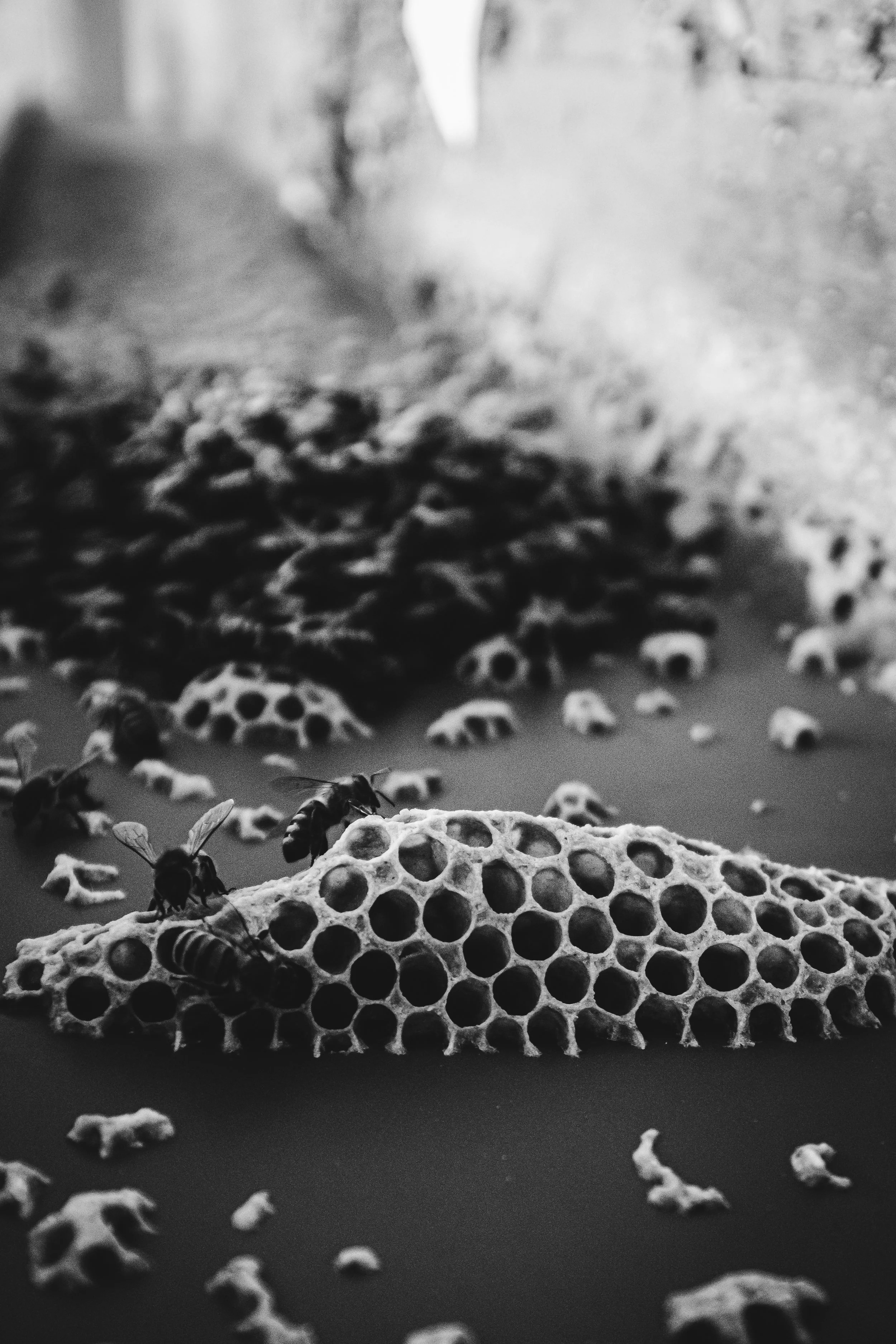
The first photograph gives me an easier start. A pale piece of comb stretches across the foreground, with a few bees along its edge. The openings are clear against the darker surface beneath it. Further back, the picture softens into scattered pieces and a gathering of bees that’s harder to separate.
There’s room around the foreground group. I can make out a wing or the curve of a body without immediately having to decide which bee it belongs to. That becomes rather more of a task in the second picture.
There, the frame is full. Bodies point in different directions, legs disappear underneath neighbours, and wings overlap. Some details are sharp enough to distinguish; others fall into the darker spaces between them.
The pale wings catch my attention first. Their fine lines show up against the bodies beneath, while the stripes on the abdomens give the eye another pattern to follow. Black and white makes those differences especially noticeable. There’s plenty to look at before I’ve worked out quite how everyone fits.
Usually, recognising a bee is enough. It’s a bee. You might watch where it lands, or take a little more interest if it comes near your drink. These photographs bring the smaller details forward: the hair around a head, the veins in a wing, the legs tucked among all those bodies.
That changes the scale of things. A wing becomes a surface with detail of its own. A piece of comb has edges and irregularities, rather than just the pattern I expect it to have.
The comb in the first picture is particularly good for this. The pale rims stand out, but they aren’t all identical. Some openings are rounder, some more angular, and the outer edge is uneven. It gives the photograph something substantial beneath the bees, with the softer background leaving that foreground detail clear.
Placed together, the pictures offer a useful change of pace. I can spend time with a few distinct shapes, then move into a frame where they’re much harder to untangle.
I like the crowded photograph for that reason. It takes a little longer to find my bearings. A bee near the centre seems a reasonable place to begin, until a bright wing draws me further right and I lose track of the one I started with.
Nothing in the photograph has moved. I’m the one who can’t keep my place.