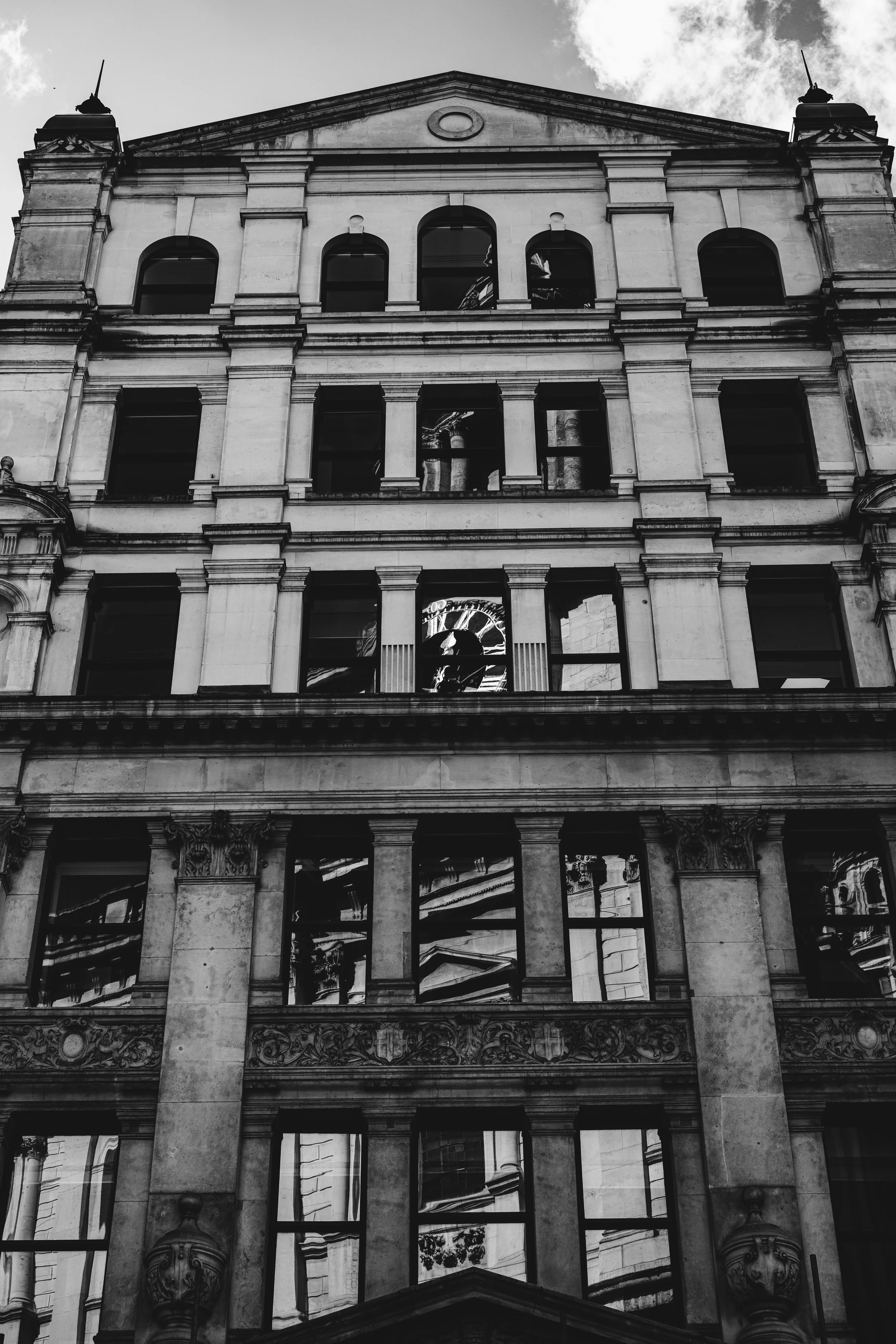
I’ve always liked the bits of London you don’t get directly. The side-glances. The reflections. The way the city seems to spend half its time looking at itself in other people’s windows, like it’s checking whether it’s still got it. Which it usually has, annoyingly.
This was one of those moments where you think you’re photographing a building, but you’re actually photographing someone else’s glass. You get the big, solid façade doing its usual heavy lifting, all stone confidence and straight lines, and then the windows start misbehaving. Instead of giving you a neat view of whatever’s inside, they hand you St Paul’s, folded and stretched and slightly warped, like the city’s been put through the wash on the wrong setting.
It’s a funny kind of honesty, that. In real life St Paul’s is there whether you notice it or not, sitting in the background of your day like a landmark with a strong pension. In the reflection it becomes something else, less certain. It’s still recognisable, but only just, like you’re remembering it rather than seeing it. The dome turns into a suggestion. The lines go wobbly. The whole thing feels briefly human, which is not something you can say about most bits of architecture that size.
I like that the reflection isn’t polite. It doesn’t sit neatly in the centre like a postcard. It’s broken up by window frames and the building’s own rhythm, sliced into panels like the city’s been turned into a contact sheet. You can almost imagine London trying different versions of itself. One where everything’s crisp and symmetrical, and one where it’s slightly bent, slightly smug, and probably late.
There’s also something reassuring about the fact you can’t have the whole thing at once. You don’t get the cathedral and the building and the sky in a tidy, respectful package. You get layers. Surfaces. A view that only exists because two things happen to face each other across a street. It feels like the way most of London works, to be honest. The grand stuff shows up when it feels like it, usually in the background of something more ordinary, and often in a way that’s a bit inconvenient.
I took it because it looked like the city was trying to admire itself without making a fuss about it. Which is about as close as London gets to humility.