The tie is still on
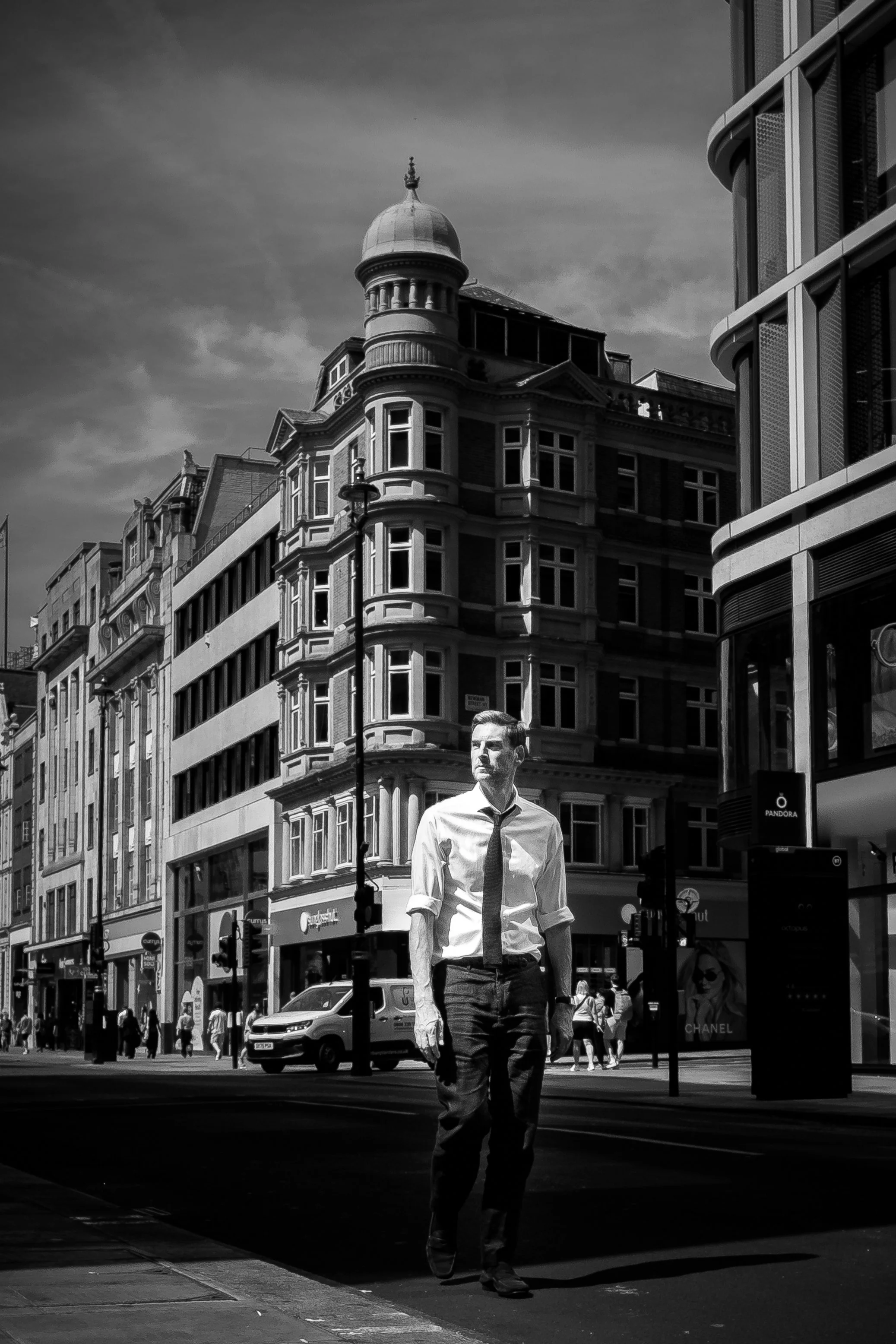
I’ve decided this man has just come out of a meeting. There’s no evidence for this, but I’ve been to meetings and I recognise the urge to put a road between yourself and one.
The sleeves are rolled up, the collar is open and the tie is still hanging on. It’s a familiar arrangement. You’ve relaxed as much as you can without having to get changed.
He could, of course, be on his way to work. He could be going to a wedding. I tend to get quite a long way into someone’s imaginary afternoon before considering that I might have the wrong day altogether.
This happens a lot when I’m out with a camera. Someone catches my eye and I start filling things in. Give me a shirt, a tie and a glance across the road and I’ll have a whole office established within seconds. There’ll be a manager, an unanswered email and someone heating up something unfortunate in the communal microwave.
The man himself hasn’t contributed any of this. He’s crossing the road.
It was the shirt that drew my attention first. There’s a lot of building in this photograph, but that patch of white holds its own. The turret, the stonework, all those windows. Plenty to look at, and I’m still looking at a bloke with his sleeves rolled up.
I like the buildings, though. They give the street a slightly grand air while everyone carries on with fairly ordinary business underneath. Shopping, deliveries, getting somewhere. Nobody seems especially overwhelmed by the architecture. You can put a dome on a building, but people will still need to find a cash machine.
Then there’s the tie.
I’ve worn enough of them to know how quickly you can become aware of one around your neck. In the morning it seems a reasonable thing to put on. Later, you’re loosening it in small increments, apparently hoping it won’t notice.
Taking it off would be straightforward, but then you have to put it somewhere. A pocket, perhaps, where it becomes a small bundle you’ll forget about until you need it again. So it stays on. Another decision postponed.
The sleeves are easier. Roll them up and you’ve done something about the situation. There’s a pleasing sense of action involved, even if the situation is simply being a bit warm.
I’m probably giving the clothes too much attention. But those small adjustments are familiar. You leave the house looking one way and gradually modify things as the day goes on. By three o’clock, the jacket is over your arm and the sunglasses are on your head, where they’re doing very little for anyone.
I once spent a considerable amount of time looking for glasses I was wearing. So I’m reluctant to judge anyone’s arrangements.
What keeps me looking at this man is the combination of the clothes and that glance to the side. There’s just enough there to get me wondering. Is he looking for someone? Checking the traffic? Has somebody called to him?
Checking the traffic is the sensible answer, given that he’s standing in a road. It’s also the answer I tend to pass over because I’ve already become interested in the meeting.
Photographs give us time to do this. In the street, he’d have moved on almost immediately. Here, I can keep inspecting the same glance until I’ve made it much more significant than it probably felt at the time.
Anyone who takes street photographs will know how tempting that is. You look through your pictures later and find yourself drawn to an expression you barely noticed when you pressed the shutter. Then you crop a little, adjust the contrast and look again. By now, a man waiting to cross the road appears to be reconsidering several major decisions.
Sometimes I’m simply pleased that the light fell where it did and the person was in the right place. That’s quite enough to make me keep a photograph. The speculation comes afterwards, usually when I’ve been sitting in front of it too long.
And this one gives me plenty of time to speculate. The bright shirt, the dark road, the rather elaborate building behind him. He looks as though he belongs to a working day I recognise, even though I know nothing about his.
Perhaps it had been a good day. Perhaps he’d finished early.
I hadn’t considered that. I’d already booked him into another meeting.