What You Don’t See Is Usually the Interesting Bit
One of the reasons I keep coming back to street photography is because it reminds me how little we actually know about the people we pass every day. We think we’re good at reading faces, body language and first impressions, but most of the time we’re guessing. We just happen to be very confident guessers.
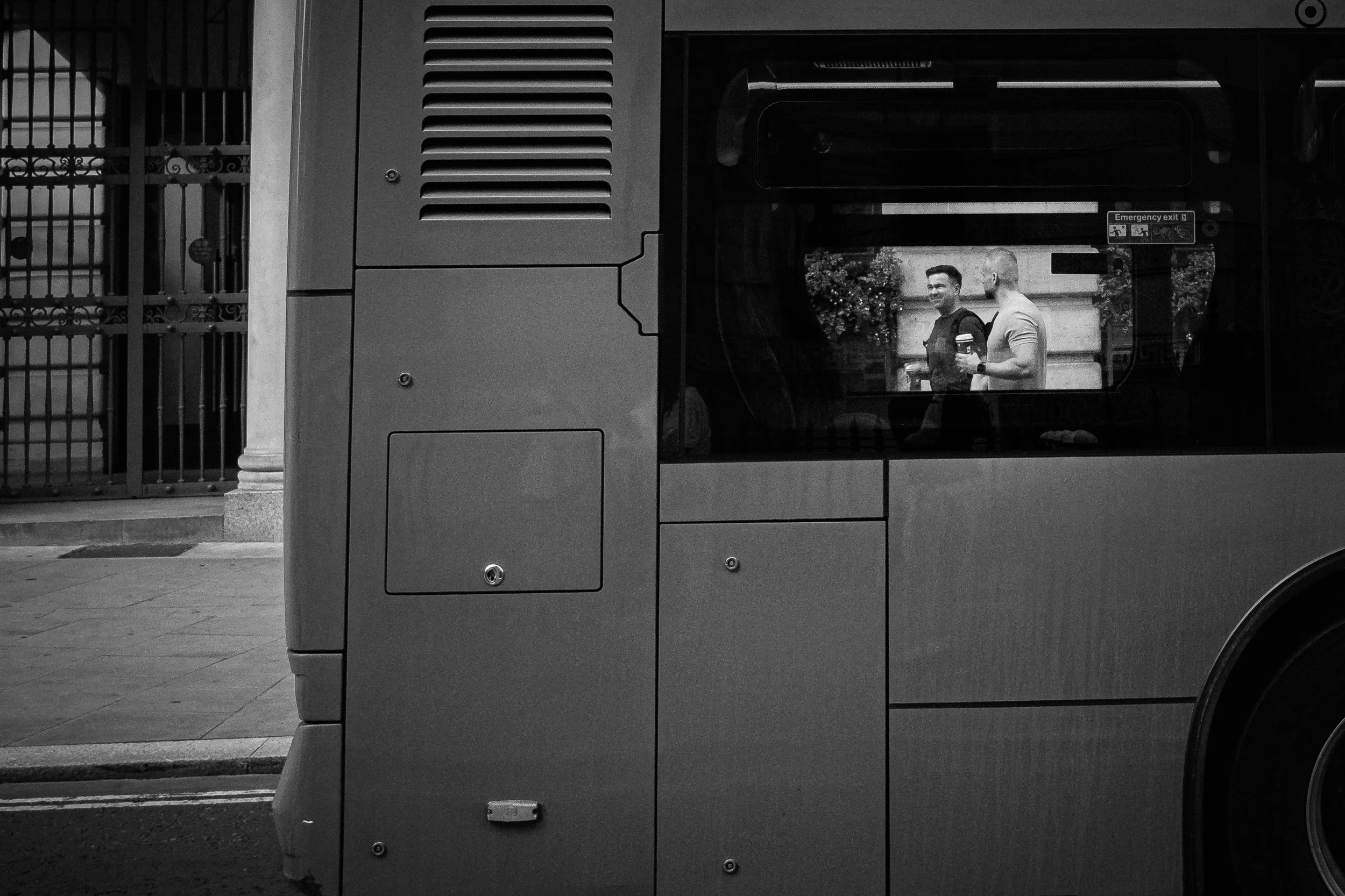
I was standing in London when a bus pulled between me and the pavement. For a second it became a moving picture frame. Through one window I caught these two men, coffees in hand, halfway through a conversation. Then the bus carried on and they disappeared with it. I never saw where they came from or where they were going.
The odd thing is that your brain doesn’t like moments like this. It immediately starts writing the missing chapters. Friends catching up? Work colleagues escaping the office? One of them telling a story he’s told twenty times before? None of it is based on evidence, but that rarely stops us. Human beings seem far more comfortable inventing certainty than admitting they don’t know.
I think that’s why documentary photography appeals to me. A good photograph asks questions instead of answering them. It leaves enough space for curiosity without pretending to explain someone’s life from a fraction of a second. That’s a habit social media has encouraged us to forget. One image, one headline and suddenly we’ve decided who somebody is.
Walking around London with a camera has probably made me less certain about people than I used to be, and I quite like that. Every photograph is a reminder that we’re all walking around carrying conversations, worries, plans and histories that nobody else can see. Every now and then you get a glimpse through the window, but it’s only ever a glimpse.
Perhaps that’s enough.