Street photography: when the reflection looks back
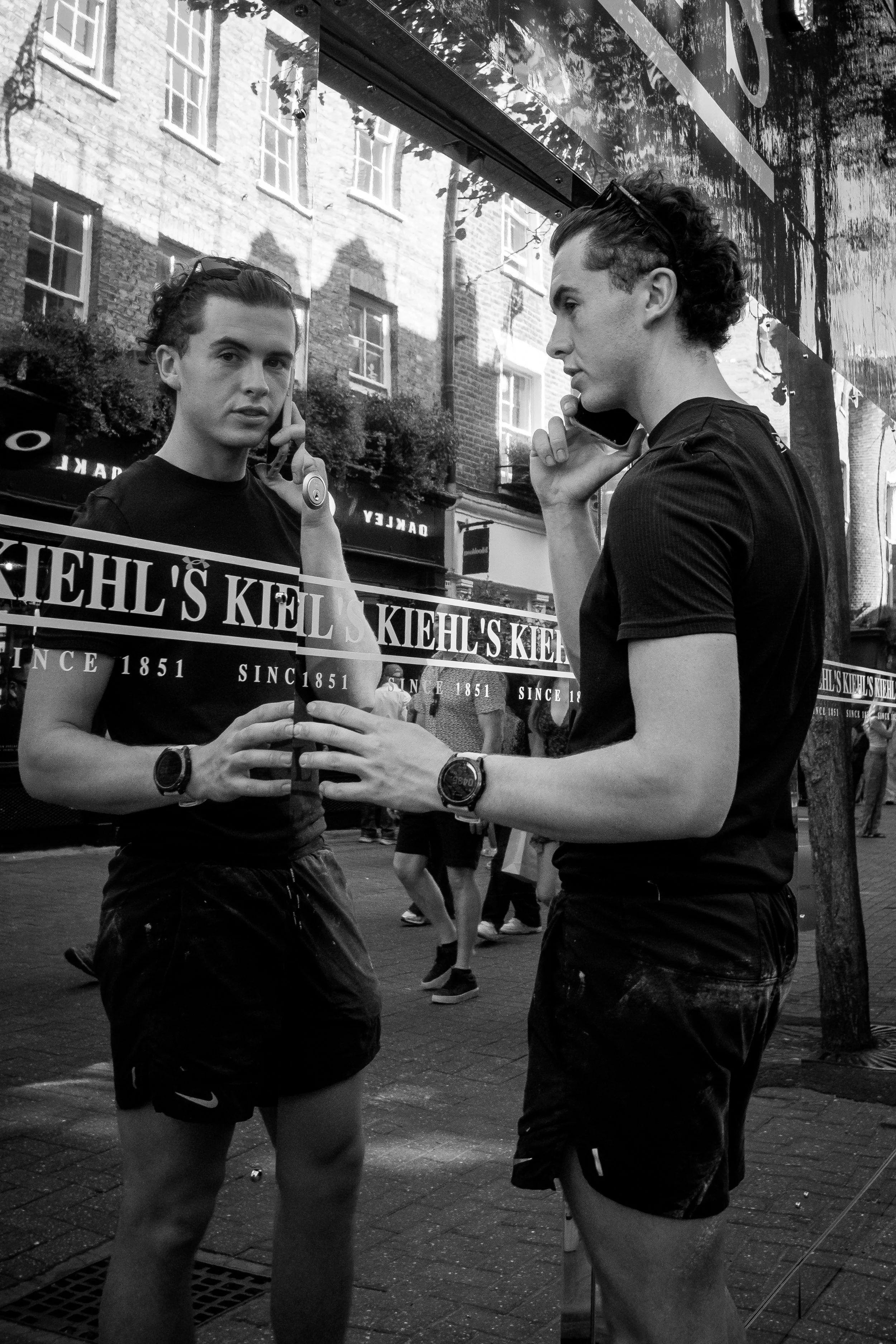
He’s on the phone. That ought to give me a moment.
Then I notice his face in the window. The man in profile looks occupied; his reflection looks as though he’s seen exactly what I’m doing. I’d been relying on the phone call rather more than I realised.
I can’t be certain he’s looking at the camera. His eyes might be directed just past me. But once I’ve noticed that glance, it becomes difficult to look at anything else. There’s a whole street reflected in the glass and I’m busy trying to establish whether I’ve been caught.
Being noticed with a camera can make you surprisingly interested in nearby buildings. You lower it and look up, as though the windows on the third floor were what you came for. It’s a fairly thin explanation when you’ve just been pointing it at someone’s head.
In this photograph, the reflection gives me that feeling even now. I look at his profile and there’s room to observe him. I look to the left and seem to have acquired an audience.
It’s the same person, of course. Same phone call, same instant. But the angle makes a difference. On the right, he appears to be listening. In the glass, his face is turned towards us, and the eyes have more presence. I keep moving between the two, finding one easier company than the other.
That’s what makes this more interesting to me than a straightforward photograph of someone on a phone. The reflection changes how I feel about looking.
His free hand is against the window too, meeting its copy at the fingertips. It’s a small detail, but it helps me make sense of the picture. With all the buildings and people showing through, I could almost forget the surface is there. The hand brings me back to it.
Shop windows give you a lot to work with. They also give you plenty to get wrong. Move slightly and a face disappears into lettering. Move again and something improves, but now your own reflection has joined in. You can spend a while finding a position where you aren’t making an unwanted appearance.
Here, the lettering still runs across him. People are walking through the reflection and the buildings opposite fill the upper part of the frame. I like having all that in there. The street hasn’t stopped just because there’s something worth photographing outside the shop.
The phone call hasn’t stopped either. Whatever the conversation is, he has more reason to be interested in that than in me. It could be something important. It could be a discussion about where somebody has parked. His expression doesn’t give me enough to choose, although I’m quite capable of choosing anyway.
A photograph leaves you plenty of time to become confident about things you don’t know. Look at a face for long enough and you start supplying a mood. A slight turn of the head becomes significant. You forget that the person might have looked entirely different a second later.
With this one, I don’t get very far into imagining his conversation. The reflected glance keeps interrupting.
And perhaps that’s why I keep returning to it. Usually, looking through a photograph is a comfortable business. I can take my time, inspect the details, decide what interests me. This one makes me a little more aware of my part in it.
He’s standing outside a shop, taking a call. I’m the one who’s made something of it.
I’ve checked the direction of his eyes several times now. Still haven’t managed to move them past me.